20 Animated LINE Emoji Ideas for Everyday Reactions [2026]
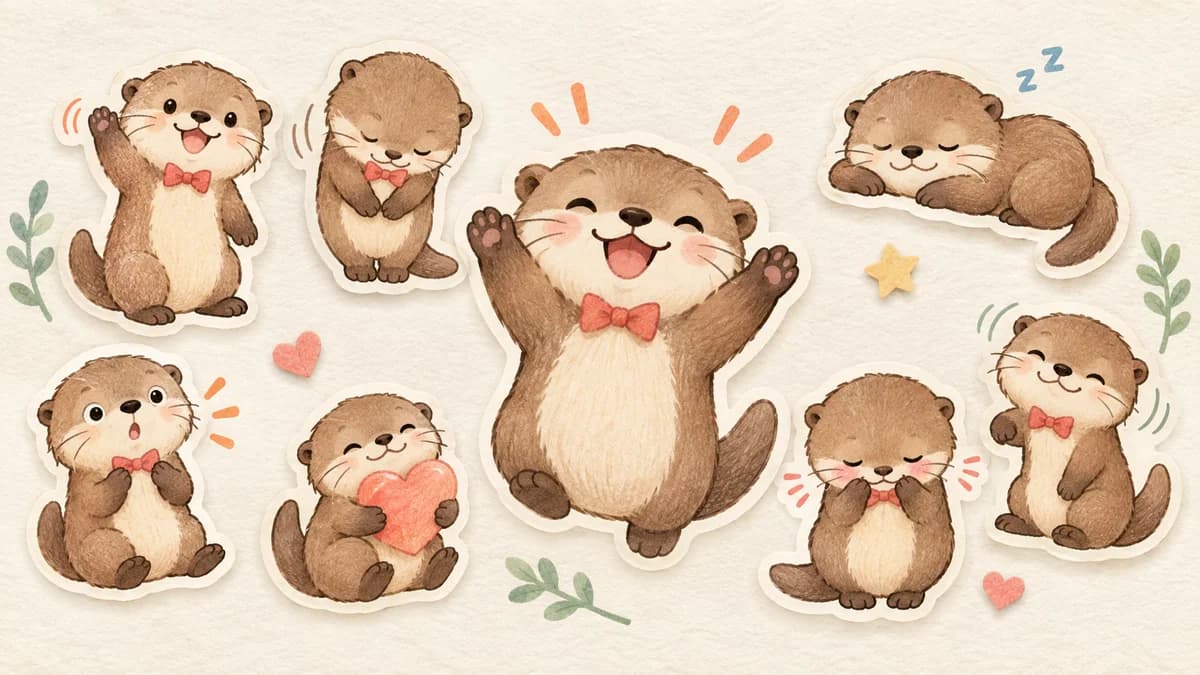
A good animated emoji set does not need twenty spectacular effects. It needs twenty small reactions you can imagine sending repeatedly. Start with your real chat habits, give each item one feeling, and choose motion that remains obvious inside a message bubble.
Build a useful set
- Cover replies and reactions before adding unusual character poses.
- Keep the face large, the outline clear, and the movement focused.
- Use short or no lettering so the emoji works beside your own sentence.
- For animated emoji, Stampo's current set options are 16, 32, and 40 items.
What current official collections suggest
Official LINE collections and seasonal themes are useful for noticing situations people recognize quickly: greetings, encouragement, thanks, surprise, tiredness, and small celebrations. Use the situations as inspiration, then build a character and wording that belong to you.
A set becomes easier to use when the expressions are distinct. If three items all mean okay, replace one with a waiting, apology, or good-night reaction so the pack covers more real conversations.
20 everyday animated LINE emoji ideas
Here are twenty starting points. Each item combines a common use with a simple movement that can remain readable at small size.
- Good morning — stretch, blink, and give a small wave.
- Hello — wave once from beside the face.
- Good night — close the eyes and settle under a tiny blanket.
- Thank you — smile and bow once.
- Sorry — lower the ears or shoulders and bow gently.
- Okay — nod clearly once.
- Got it — raise one finger and nod.
- On my way — bounce forward with a small speed line.
- Wait a minute — hold up one hand and sway slowly.
- I am home — open the arms and smile.
- Great job — clap twice or raise both paws.
- Yay! — make a small jump with a bright expression.
- Wow — widen the eyes and lean forward.
- I am tired — yawn and let the head droop.
- Hungry — look toward a small bowl or snack.
- Busy — move quickly between two tiny tasks.
- Love it — show a heart while the eyes sparkle once.
- Take care — wave slowly with a warm smile.
- See you later — wave and turn slightly away.
- Celebration — lift a small party flag or confetti burst.
How to assemble the 20 ideas into a set
Begin with the phrases you send most often and group the rest by mood. A useful order might be greetings, quick replies, thanks and apologies, daily states, then celebrations. This makes the set feel complete without forcing every item to have the same kind of movement.
Leave room for text-free emoji. A smiling face, sleepy face, heart, or surprised expression can be more flexible beside a sentence than an emoji with a long phrase embedded in it.
Check the small display before finalizing
Open the emoji inside a message bubble, send it alone, and test it as a reaction where supported. Make the face and outline large enough to survive reduction. Move one silhouette-changing part, keep the text short, and avoid decoration that hides the eyes or mouth.
The first frame must communicate the feeling without relying on a later animation frame. A nod that begins with a clear okay face works better than a blank face that only becomes meaningful after movement.
Turn the ideas into a set in Stampo
In Stampo's animated emoji creation flow, describe the character, who will use it, the phrases or text-free reactions you want, and the movement for each group. Choose 16, 32, or 40 items, then review duplicate meanings and the small-display preview before full generation.
Use the editor to correct lettering, placement, transparency, and outlier expressions. The point of the idea list is to create a strong starting structure, not to accept every candidate without review.
FAQ
Should every one of the 20 emoji include text?
No. Text-free faces and reactions are often more flexible beside your own sentence. If you add text, keep it short and confirm that it remains readable at small size.
Can I repeat the same movement in a 40-item set?
A familiar movement can be reused when the emotion or situation is clearly different, but too many near-duplicates make the set harder to use. Vary the meaning before chasing more effects.
Can I use a non-animal character?
Yes. The same planning principles work for people, mascots, food, objects, and other original characters: clear silhouette, one emotion, and a movement that survives small display.